A Brief History of FBCA
1803
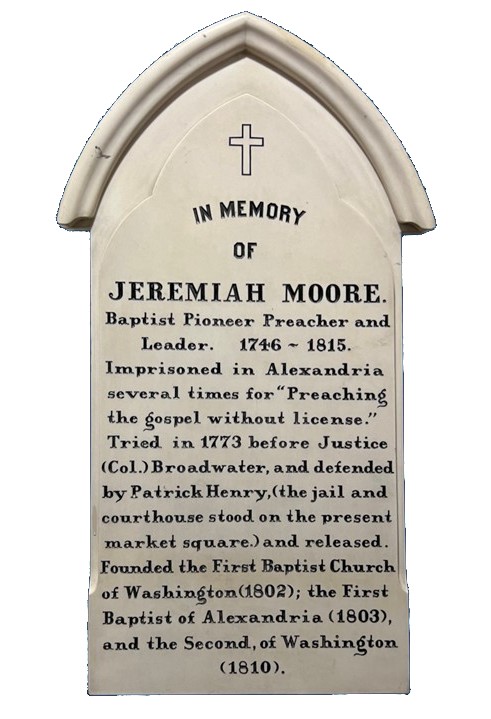
On April 16, 1803, five men and seven women of Back Lick Church in Fairfax County asked to be "dismissed agreeably...to be constituted into a regular Baptist Church in the town of Alexandria." Their request was approved, and a week later, the twelve signed a covenant in which they, "humbly desiring to be constituted into a regular church, hoping it may be for the glory of God...do hereby as in the presence of His Supreme Majesty, solemnly unite as a regular society to worship Him and promote His ordinances, maintain His truth and endeavor to promote His Glory in the world." The group, with $1,988.87 borrowed from a charter member, Alexander Smith, erected a humble meeting house and called Jeremiah Moore as their first pastor.
Moore was one of the most prominent traveling preachers of his day. In the late 1760s he converted from the established Church of England to the Baptist faith. During the early years of his ministry, it was illegal to preach any doctrine not conforming to the tenets of the Church of England. Moore was jailed for preaching in Alexandria, but he continued to share the Gospel to huge crowds from his jail windows. When finally brought to trial, he was defended by Patrick Henry, a vigorous proponent of religious liberty. Henry is reported to have said to the court, "Great God, gentlemen! A man in prison for preaching the gospel of the Son of God?" Moore was set free. He later wrote of the experience, "I have felt the effects of the ecclesiastical establishment and have been told by the Judge from his seat 'you shall lay in jail until you rot' when my only crime was no other than that of preaching the Gospel of Jesus Christ."
Moore was one of the most prominent traveling preachers of his day. In the late 1760s he converted from the established Church of England to the Baptist faith. During the early years of his ministry, it was illegal to preach any doctrine not conforming to the tenets of the Church of England. Moore was jailed for preaching in Alexandria, but he continued to share the Gospel to huge crowds from his jail windows. When finally brought to trial, he was defended by Patrick Henry, a vigorous proponent of religious liberty. Henry is reported to have said to the court, "Great God, gentlemen! A man in prison for preaching the gospel of the Son of God?" Moore was set free. He later wrote of the experience, "I have felt the effects of the ecclesiastical establishment and have been told by the Judge from his seat 'you shall lay in jail until you rot' when my only crime was no other than that of preaching the Gospel of Jesus Christ."
1805
Thomas Jefferson gives $50 to Alexander Smith "for a Baptist church in Alexandria."
1816
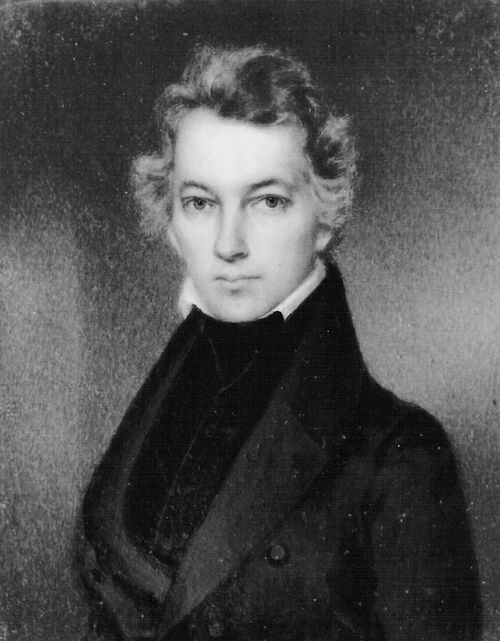
Spencer Houghton Cone becomes FBCA's third pastor, succeeding John Paradise. A former actor and soldier, Cone's inspired preaching helps grow the congregation to over 300.
1821
President George Washington had long advocated for the establishment of a university in the District of Columbia. When he died in 1799, he left a bequest in his will toward that goal, and both Thomas Jefferson and James Madison supported efforts to bring Washington's dream to fruition. Pastor Cone and other Baptist ministers spent years petitioning as well, until in 1821 President James Monroe signed an Act of Congress creating Columbian College, which later became George Washington University. Early leaders of FBCA were active as trustees of the new institution.
1829
On November 28, a fire destroyed the First Baptist Church meeting house in Alexandria. At the December 30 business meeting, it was reported that "much kindness and liberality from our citizens generally" had been shown in giving to the church. The Building Committee recommended that Pastor Samuel Cornelius "travel abroad to solicit subscriptions to aid us in the rebuilding of our house." Cornelius toured the South on horseback to raise money for a new building.
1840s
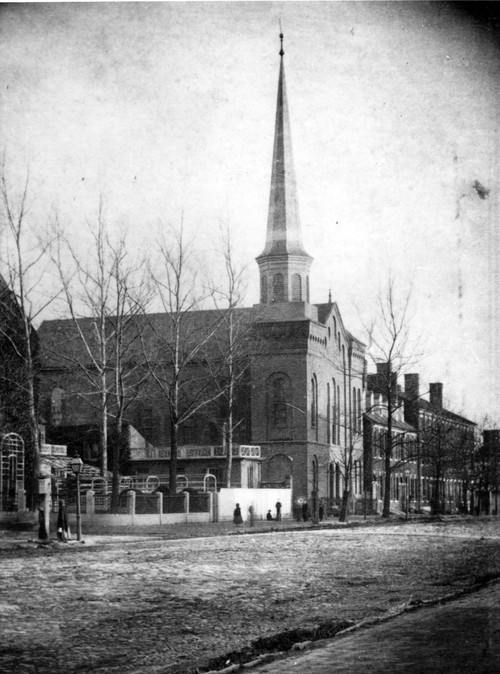
A growing dispute over missionary activities split First Baptist into two factions, one opposing any efforts toward evangelism and the other group supporting the spreading of the Gospel. For a time, the anti-missionary members occupied the church building, forcing the pro-missionary group and the pastor to meet across the street in the Lyceum. A court decision settled the matter in favor of the pro-missionary group. Slowly, spirits healed and the church reunited.
1859
Construction of a new and larger church building at 212 South Washington Street was completed, and dedication services were held on the first Sunday of June.
1860s
While the Civil War caused many churches to halt regular services, First Baptist Church continued holding worship services on Washington Street until June, 1862, when, in the midst of Sunday worship, a Union military guard seized the church building for use as a hospital. The church met for a time in a building on Cameron Street, and in 1864, the pastor, Dr. C.C. Bitting, was arrested and jailed for not submitting to the demands of Union authorities. He was later arrested again and deposed from the ministry because of his refusal to "publicly and approvingly pray for the President of the United States and for the Army and Navy." Dr. Bitting appealed to President Lincoln, stating that Baptists throughout their history have stood for complete separation of church and state. As a matter of conscience, they "refrained from all complications of religious matters with civil, political, or military affairs." He asked that the church building be returned to the congregation and the church be reimbursed for damages. Federal authorities returned the building to the church in 1865, but it wasn't until 50 years later that the government settled with the church for rent and damages in the amount of $3,900.
1885
The Women's Missionary Society was organized, followed by the Baptist Young People's Union (forerunner of the Baptist Training Union) in 1892.
1903
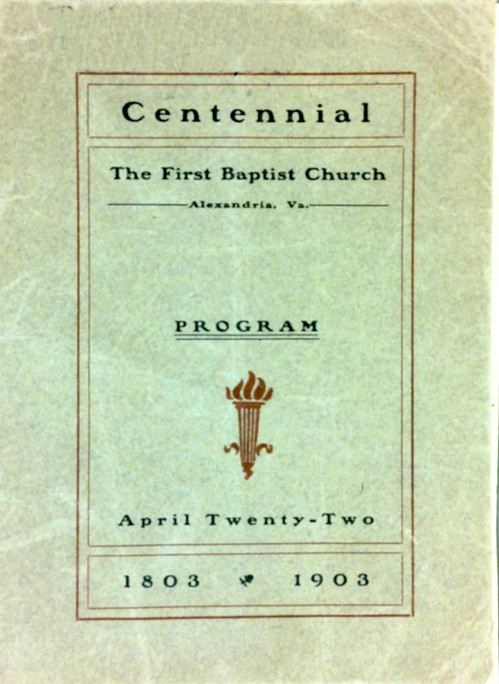
FBC Alexandria celebrated its centennial with a week-long celebration.
1916-1923
FBCA added more than 600 members during the time that Dr. Eugene B Jackson was pastor.
1952
Members of FBCA were instrumental in the formation of the Mount Vernon Baptist Association, which later became the NorthStar Church Network.
1954
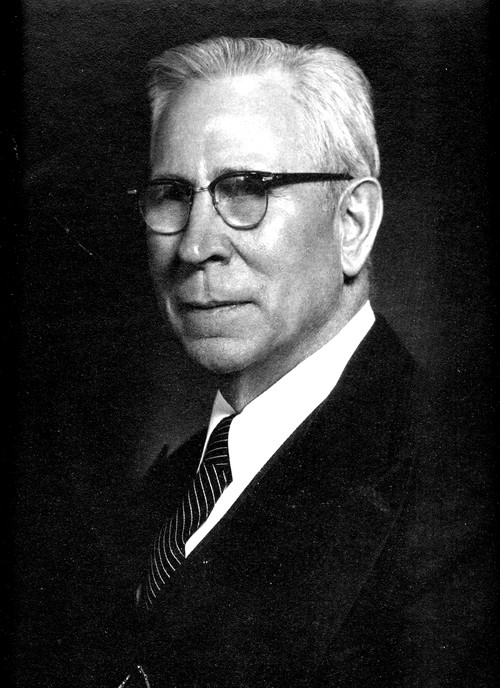
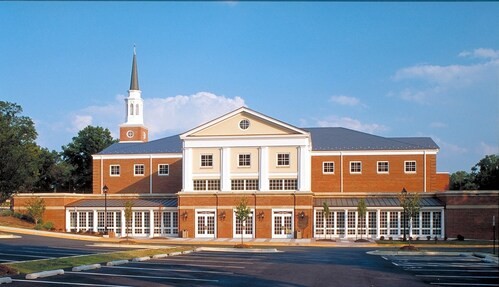
Fulfilling the vision of Dr. Ernest F. Campbell, FBCA purchased land on King Street for the construction of a new church building. In 1952, ground was broken and in May, 1954, after 101 years in its Washington Street location, the congregation held the first worship service in their new home.
1963
An education wing was added on the south side of the building, providing much-needed classroom space for a growing multi-generational congregation.
1987
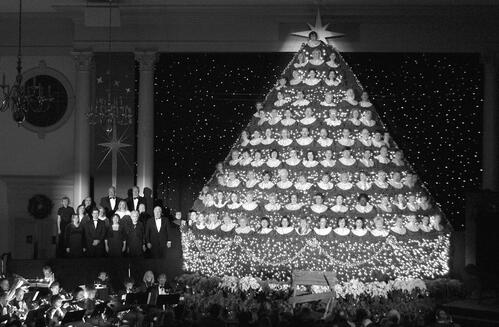
The first Living Christmas Tree is held, launching a series of annual performances that lasts until 2015.
2000
The new Faith Activities Center opened, featuring a large multi-purpose function area and a music suite with rehearsal rooms and offices.
2003
FBCA commemorated its 200th anniversary with numerous activities that culminated in a weekend-long celebration of music, worship, remembrances, and a promising vision of the years to come.
2020
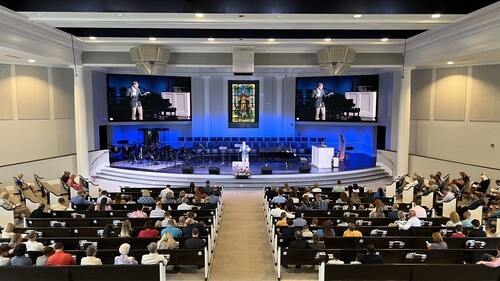
After three years of construction , the newly renovated sanctuary opened during the COVID-19 pandemic. Shortly afterward, the redesigned children's area on the lower level opened.